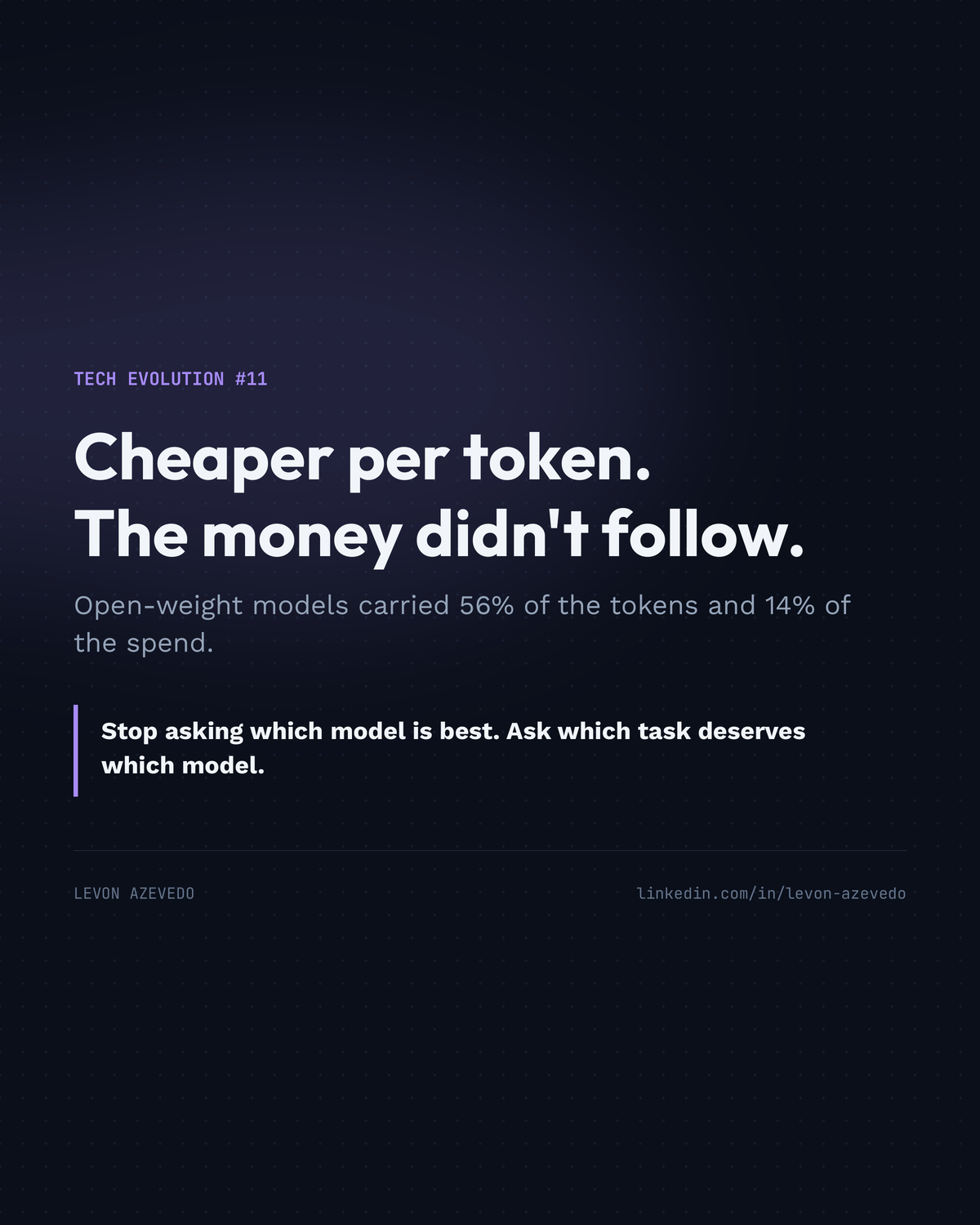
The September reports describe a substantial fall in AI token prices. The money did not follow the tokens. The distance between those two facts is where much of the practical engineering work in applied AI now sits, and the September production and business-spend reports make the gap unusually easy to see.
The volume moved
Vercel's AI Gateway Production Index, published on the seventeenth of September, reports that in August open-weight models carried the majority of tokens on its gateway for the first time: fifty-six percent of the volume, but only fourteen percent of the spend. The average token cost less than half what it had five months earlier. Among teams running more than ten million tokens, the median team paid seven point six percent less per token in the month.
The money did not
The same index shows spend concentrating rather than spreading, with a single frontier model rising to more than a fifth of gateway spend. Ramp's AI Index, published on the ninth of September and built from corporate card and bill-pay data, tells a similar story. The price it tracks fell forty-one percent from its March peak, and most of the volume growth came from cheaper standard models. Frontier models still drove forty-five percent of token share. Cheap models carry the bulk of the traffic. Expensive ones carry the work that someone is willing to pay for.
The evidence against
This reading has limits. Vercel describes aggregate traffic through one gateway, not the whole market. Its spending figures use published list prices, so actual bills may differ. By Ramp's count, only six point four percent of AI-spending businesses used routing platforms that could provide open-source models. Ramp cautions that those platforms also serve closed models, so actual open-source adoption may be lower. Ramp also notes that AI spend tends to dip in August, when many engineers take time off. In Canada, the story is still adoption rather than optimization. Statistics Canada reported on the thirty-first of August that a quarter of businesses plan to use AI in the next year, up from about one in seven a year earlier, while more than half have no plans at all.
What to do with it
For teams already running AI in production, the useful question is no longer which model is best. It is which task deserves which model. Write that down as a routing table with an owner. Price it per task, not per token. Put the cheaper model through a security review before it touches customer data. And revisit the table every month, because the prices beneath it moved by forty-one percent in six months.