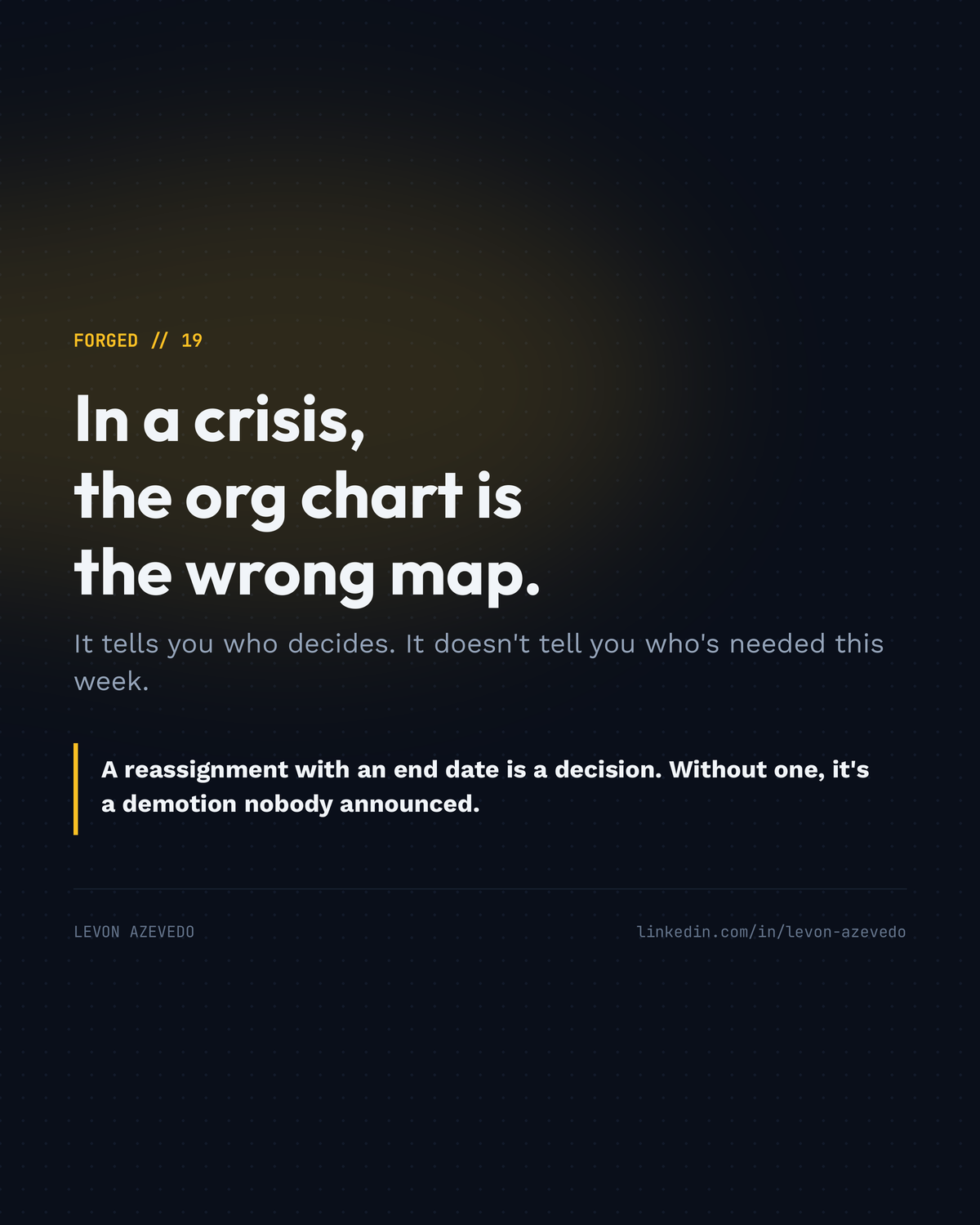
An organization chart is a good answer to a calm question: who decides what, and who reports to whom. It is a poor answer to the question a crisis actually asks, which is simpler and more urgent. Who is needed, where, this week?
In a crisis, start by counting what remains, who can do what, and where the gaps are. Not planning, not assigning blame, not escalating. Counting. Rank comes after that inventory, because rank describes the organization you had on Monday, and the crisis is happening to the one you have now.
Why teams stay in their lanes
When pressure arrives, most teams respond by working harder inside the boundaries their titles already drew. It feels responsible. It is also how a late module stays late with the same two people on it, while capable colleagues a desk away stay busy with work that could comfortably wait a week. Nobody decided that outcome. The chart decided it by default. And because everyone is visibly busy, the misallocation is almost impossible to see from inside the team that is living it.
Three habits that move the work
The first habit is to take inventory before reassigning anyone. List every open problem and, next to it, the person who can actually close it in the next five days. Not the person who owns it on paper. The two lists rarely match, and the difference between them is the real shape of the crisis.
The second is to move people toward the constraint and to say, out loud, how long the move lasts. A reassignment with an end date is a decision the whole team can understand. Without an end date, it reads as a demotion that nobody announced, and people protect themselves accordingly.
The third is to let titles keep their decisions while the work moves. A senior engineer can pair under someone more junior who knows the failing module better. Authority stays where it was. Effort goes where it is needed. Those are two different resources, and a crisis only asks you to reallocate one of them.
Where I learned it
I delivered an ERP implementation in 45 days. A deadline that short makes one thing obvious very quickly: the schedule never cares who is senior. It cares which module is behind.
The line to keep
Rank tells you who decides. Function tells you who is needed. In a quiet quarter, the two point in roughly the same direction. In a crisis they separate, and confusing them costs you exactly the week you cannot afford.
So the question worth asking after your last crunch is a plain one. Did the work move to where the problem was, or did it stay where the org chart had put it?