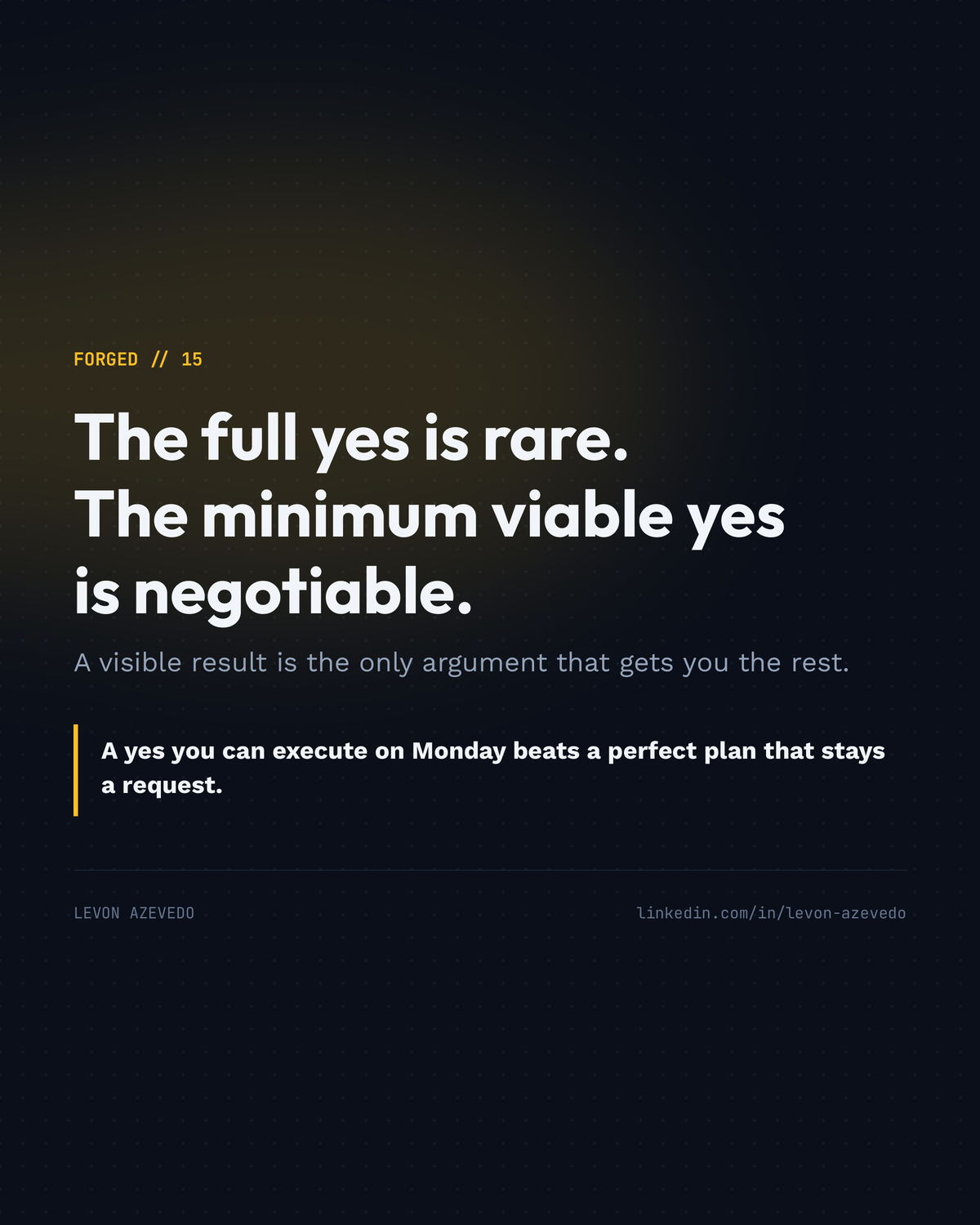
A full yes is rare. That does not make a smaller yes meaningless. It makes its design more important.
The trap in a constrained conversation is to treat one large request as the only request. An hour with the decision-maker. A full budget. A complete team. A finished plan. When the answer is not now, the work can seem to have stopped. Usually, the conversation has only revealed that the ask was too large to evaluate without evidence.
The useful next question is smaller: what can this person approve that creates something visible?
A visible result changes the conversation because it gives everyone an object to judge. It is no longer a promise about what might exist after more time, more budget, or more attention. It is a screen, a prototype, a short customer test, a repaired flow, a decision memo with real tradeoffs. It makes the next request concrete.
Design the smallest commitment that can teach you something
Small is not the same as vague. A minimum viable yes needs three properties.
First, it has a boundary. Name the piece that will be delivered, and name what it deliberately does not include. A limited commitment becomes useful when nobody mistakes it for a quiet promise of the whole programme.
Second, it has a date. Without one, "start small" is only a softer way to defer the work. A date creates a moment when the result can be inspected and the next decision can be made.
Third, it has an evidence question. Before starting, decide what the small piece should prove. Is the goal to show a customer a working path? To learn whether people understand an offer? To establish that a technical risk is real? To earn the next hour with the person who can remove a constraint? The evidence does not have to be dramatic. It does have to be legible.
That distinction matters because partial agreement is easy to misread. A small approval can feel like a concession from the person asking, or a defeat when it falls short of the original plan. It is neither if it buys a real test. It is a down payment: a bounded commitment that carries an obligation to return with what it produced.
Keep the next ask honest
There is a discipline on the other side of this. Do not use a small yes to smuggle in the full plan. If the boundary was one screen, build one screen. If it was a short test, run the test and report what happened. Credibility comes from making the limited agreement visible, not from treating it as permission for everything it resembles.
The same discipline makes the follow-up easier. Return on the date with the evidence, the limitation, and the next decision. The result may justify expanding the work. It may show that the assumption was wrong. Both outcomes are useful because both replace an abstract argument with information.
A perfect plan that cannot start is not yet a plan in motion. A smaller commitment, executed well, is. The work is to find the smallest version that creates a result someone else can see — then make that result good enough to deserve the next yes.
Forged is a Journal series about building leverage under constraint.