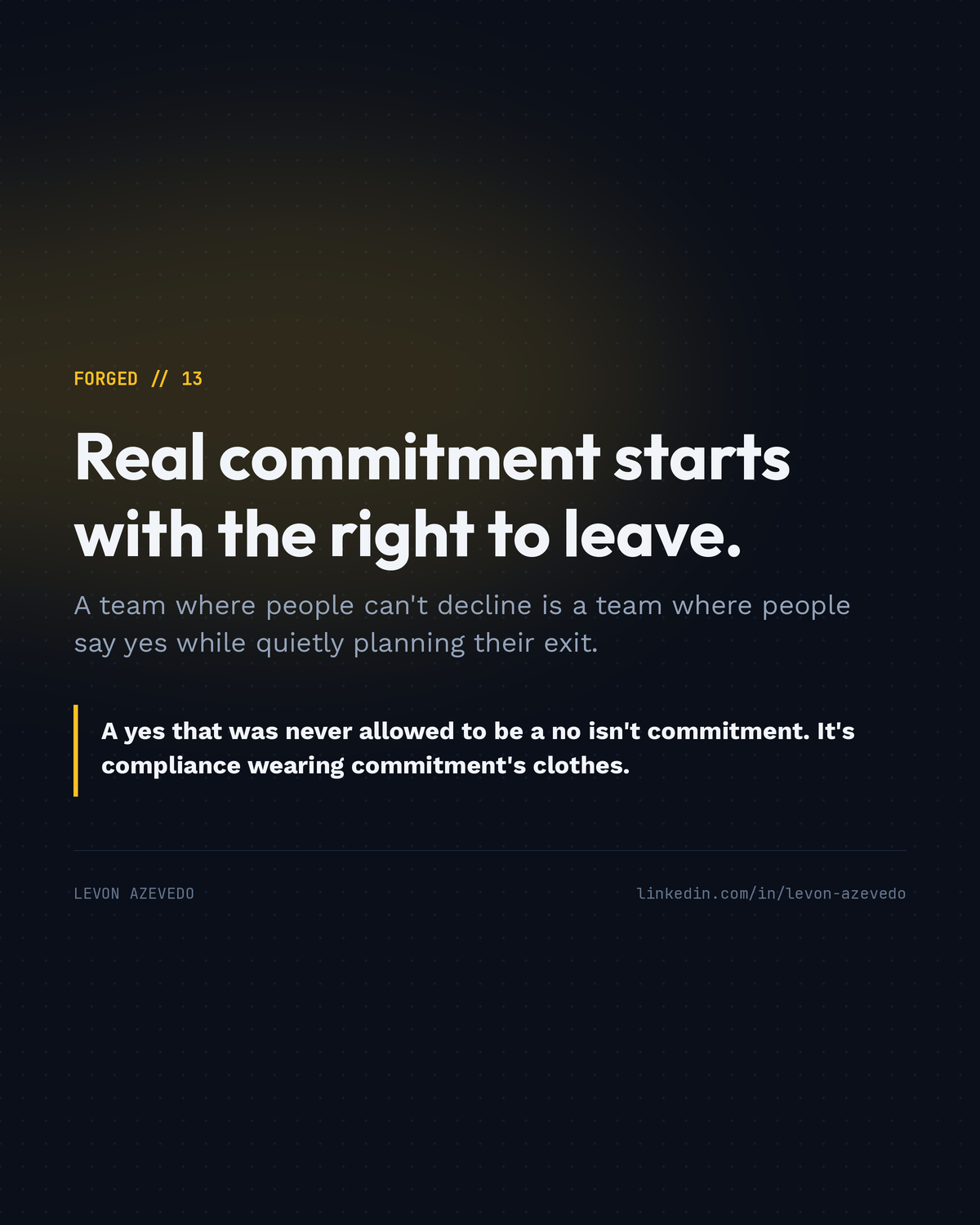
A team needs a meaningful way to decline critical work before treating agreement as commitment. A yes is hard to interpret when the person believes that saying no will cost them their standing.
Before assigning a high-stakes task, explain the work, the constraints and the support available. Give the person room to state that they cannot take it on. Listen for capacity, capability and conflicts instead of treating hesitation as a character problem.
An exit offered only for appearance does not help. If declining leads to punishment or a meeting designed to change the answer, the team learns to hide its reservations. Those reservations will still affect the work after the assignment is made.
A clear no at the beginning can be easier to plan around than a nominal yes followed by weeks of quiet underperformance. It reveals a staffing decision while there is still time to make one.
For critical work, record the agreement and its boundaries. State what the person is taking on, for how long, and how either side can raise a problem. Commitment becomes useful when both parties understand what they are committing to.
The next time you need an answer, consider whether the person has enough room to give you an honest one.